Last week Google changed its algorithm for determining the quality score of landing pages being advertised in its pay-per-click program Adwords. This development had a major impact on the rankings and the cost-per-click price that advertisers are paying. This was done to improve the relevance of its paid search results, attempting to improve the user’s experience.
What is a Google's Quality Score?
Google's quality score is a rating number for how relevant your landing page is related to the keyword you are bidding on. The Quality Score is in place to keep the paid results in Google to be as relevant to the term searched as possible.
How does Google Determine the Quality Score of a Landing Page?
Google's quality score rating is a totally automated system that determines this number. Since there is no human involvement in this score, it is solely established by what Google's bot can read. If you do not have relevant text, H1, Meta tags, keywords, and descriptions on your landing page(s) your quality score has most likely suffered greatly.
Effects of a Low Quality Score
A low quality score will cause 1 of 3 things to happen within your ad campaign on Google.
1. Your ads will be pushed down on the results of the first couple of pages for each respective keyword.
2. You will see a huge spike in your cost-per-click amount (this is because lower rated pages need to spend more money to be listed).
3. Your keywords will become "inactive for search" which means that the combination of your quality score and maximum cost-per-click bid is not a high enough total score to even make paid search results.
How to Improve a Low Quality Score
A low quality score can only be improved by improving the on page relevance of your landing pages to the keywords you are bidding on. I personally would recommend creating at least 1 landing page for each Ad Group within your Adwords campaign. This may take some time, or money, but this action will lower your bidding cost and improve your paid results ranking which can easily save you thousands of dollars annually.
Wednesday, July 26, 2006

Friday, July 21, 2006
Online Travel Marketing on The Move
SmarterLiving.com's Krista Pappas talks with our news editor about the challenges of the online travel industry, search engines and metrics that matter.
Roger Park: Can you give me an overview of BookingBuddy and your role at the company?
Krista Pappas: BookingBuddy is a part of Smarter Living, Inc., an online travel network which publishes two sites: Booking Buddy and SmarterTravel.com, an online travel magazine. We consider ourselves to be a new breed of travel site that specializes in comprehensiveness, and we help consumers find great deals and easily plan the best itineraries for their travel needs. We currently have more than 130 commercial partners including Kayak, Starwood, United, Expedia, Travelocity, Priceline, Hilton and Enterprise, who have chosen to partner with us as an alternative to higher cost channels.
As a senior vice president at Smarter Living, my role includes strategy for our products and the company's commercial relationships.
Park: What is the current state of online travel marketing?
Pappas: Because there has been an increase in the amount of web pages containing some form of user-generated content, it makes what people say about your brand and your product even more important. Marketing extends beyond just advertising online, as consumers are becoming more savvy and less loyal, and the internet allows them to quickly move on to a competitor if their experience with your brand and products does not completely satisfy their needs. Travel marketers need to work very hard to lead the way by finding ways to get people to talk positively about their brand and their product; making it critical that the experiences people have with the brands and products be positive and meet and surpass expectations.
Read the full article
Roger Park: Can you give me an overview of BookingBuddy and your role at the company?
Krista Pappas: BookingBuddy is a part of Smarter Living, Inc., an online travel network which publishes two sites: Booking Buddy and SmarterTravel.com, an online travel magazine. We consider ourselves to be a new breed of travel site that specializes in comprehensiveness, and we help consumers find great deals and easily plan the best itineraries for their travel needs. We currently have more than 130 commercial partners including Kayak, Starwood, United, Expedia, Travelocity, Priceline, Hilton and Enterprise, who have chosen to partner with us as an alternative to higher cost channels.
As a senior vice president at Smarter Living, my role includes strategy for our products and the company's commercial relationships.
Park: What is the current state of online travel marketing?
Pappas: Because there has been an increase in the amount of web pages containing some form of user-generated content, it makes what people say about your brand and your product even more important. Marketing extends beyond just advertising online, as consumers are becoming more savvy and less loyal, and the internet allows them to quickly move on to a competitor if their experience with your brand and products does not completely satisfy their needs. Travel marketers need to work very hard to lead the way by finding ways to get people to talk positively about their brand and their product; making it critical that the experiences people have with the brands and products be positive and meet and surpass expectations.
Read the full article
Friday, July 07, 2006
Website Conversion Erosion
Test key pages regularly and conduct competitive analysis to combat declining website conversion rates.
Even the best landing pages and websites can experience an erosion of their conversion rates. Why does this happen? And how can you prevent it?
Nothing remains the same online. You may create a high-converting site or page and then notice over time that conversion rates begin a slow but steady decline.
There are a number of possible explanations. New competitors may have entered the market. Bidding for your PPC keywords may have risen steadily. Marketing support for the new page or site may have declined or lost its impact.
Here is an example of a site we tracked over a period of almost a year and a half. Although the erosion of conversion rates is not even, it is steady.
Read The Rest Of The Article
Even the best landing pages and websites can experience an erosion of their conversion rates. Why does this happen? And how can you prevent it?
Nothing remains the same online. You may create a high-converting site or page and then notice over time that conversion rates begin a slow but steady decline.
There are a number of possible explanations. New competitors may have entered the market. Bidding for your PPC keywords may have risen steadily. Marketing support for the new page or site may have declined or lost its impact.
Here is an example of a site we tracked over a period of almost a year and a half. Although the erosion of conversion rates is not even, it is steady.
Read The Rest Of The Article
Tuesday, June 27, 2006
Yahoo Has The Answers, Google Still Searching
GOOGLE MAY BE THE KING of search, but in one area at least, Yahoo is kicking Google's can around the block. The upstart Yahoo Answers has blown by the venerable Google Answers (venerable at least by Internet time, having been around since May 2002), and seems to be drawing rave reviews from analysts and users alike. The service launched in December of 2005, and had its 10 millionth question posted in May. When it comes to share of the online answer market, it has amassed about 10 times the traffic that Google Answers has in the past 6 months, according to Hitwise.
Everything Old is New Again
Posting questions online is nothing new. Ask Jeeves' AnswerPoint was around long before either Google or Yahoo, starting in early 2000. But it never took off, and was wrapped up in May of 2002 (ironically, the same week Google Answers launched). According to Ask head Jim Lanzone, "AnswerPoint wasn't a failure, nor a smashing success." At the time, Ask Jeeves had to focus on things like the continuing integration of Teoma and the launch of Smart Answers (Ask's version of vertical shortcuts, a la Google's Onebox or Yahoo's Shortcuts), and decided to pull the plug on AnswerPoint. Lanzone remembers that "the user base was actually pretty upset about it; they were a very small, but very loyal group." LookSmart also went down this path with LookSmart Live, born in 1999 but long since faded away.
When it comes to Yahoo Answers, success seems to lie at the convergence of a number of tried and true online concepts. First of all, the answer service depends on community. Unlike Google, there's no cost to the service. It relies on its community to answer posted questions, giving it a viral vitality somewhat like a wiki or forum. Coming from Yahoo, it's of course categorized and searchable, giving users the opportunity to tap into the existing answer base to see if their question has already been answered. And it provides the wisdom of the masses, giving its community the ability to rate posted answers, thereby vouching for the reliability of the information.
Read the full article
Everything Old is New Again
Posting questions online is nothing new. Ask Jeeves' AnswerPoint was around long before either Google or Yahoo, starting in early 2000. But it never took off, and was wrapped up in May of 2002 (ironically, the same week Google Answers launched). According to Ask head Jim Lanzone, "AnswerPoint wasn't a failure, nor a smashing success." At the time, Ask Jeeves had to focus on things like the continuing integration of Teoma and the launch of Smart Answers (Ask's version of vertical shortcuts, a la Google's Onebox or Yahoo's Shortcuts), and decided to pull the plug on AnswerPoint. Lanzone remembers that "the user base was actually pretty upset about it; they were a very small, but very loyal group." LookSmart also went down this path with LookSmart Live, born in 1999 but long since faded away.
When it comes to Yahoo Answers, success seems to lie at the convergence of a number of tried and true online concepts. First of all, the answer service depends on community. Unlike Google, there's no cost to the service. It relies on its community to answer posted questions, giving it a viral vitality somewhat like a wiki or forum. Coming from Yahoo, it's of course categorized and searchable, giving users the opportunity to tap into the existing answer base to see if their question has already been answered. And it provides the wisdom of the masses, giving its community the ability to rate posted answers, thereby vouching for the reliability of the information.
Read the full article
Monday, June 19, 2006
Netscape Relaunches with Blog Focus
Netscape has reinvented itself and aims to merge news reporting and blogs.
The new version of Netscape will be lead by Jason Calacanis, a seasoned dotcom news entrepreneur who sold his blog company Weblogs to AOL last year for $25 million.
"I don't think journalism is broken at all. But some things can come faster," Calacanis told Reuters.
Netscape, which was known as a popular web browser, was bought by AOL in 1999 and is now a unit of Time Warner.
The Netscape relaunch is seen as another attempt for Time Warner to generate more online advertising sales and subscriptions to the declining AOL internet service.
The new Netscape site will feature news stories grouped under categories such as top stories, world, local news, movies, health and sports
The new version of Netscape will be lead by Jason Calacanis, a seasoned dotcom news entrepreneur who sold his blog company Weblogs to AOL last year for $25 million.
"I don't think journalism is broken at all. But some things can come faster," Calacanis told Reuters.
Netscape, which was known as a popular web browser, was bought by AOL in 1999 and is now a unit of Time Warner.
The Netscape relaunch is seen as another attempt for Time Warner to generate more online advertising sales and subscriptions to the declining AOL internet service.
The new Netscape site will feature news stories grouped under categories such as top stories, world, local news, movies, health and sports
Thursday, June 15, 2006
MySpace Looking for Search Partner
News Corp.'s MySpace.com says that it plans to solicit bids for a partner to provide its online social network with search-based advertising.
MySpace plans to solicit bids from the top three internet companies: Microsoft Corp., Google, Inc. and Yahoo! Inc.
Currently MySpace says 80 percent of its sales come from remnant sales or bulk sales of unused ad space. Twenty percent of the total sales come from display ads. MySpace has about 85 million members but the company says they have not fully exploited the advertising sales opportunities.
"We've just scratched the surface of how to monetize it," says News Corp. Chief Operating Officer Peter Chernin.
News Corp. purchased MySpace last year for about $580 million.
MySpace plans to solicit bids from the top three internet companies: Microsoft Corp., Google, Inc. and Yahoo! Inc.
Currently MySpace says 80 percent of its sales come from remnant sales or bulk sales of unused ad space. Twenty percent of the total sales come from display ads. MySpace has about 85 million members but the company says they have not fully exploited the advertising sales opportunities.
"We've just scratched the surface of how to monetize it," says News Corp. Chief Operating Officer Peter Chernin.
News Corp. purchased MySpace last year for about $580 million.
Friday, June 09, 2006
Offline Conversion Tracking and SEM
I recently read a great article on Clickz.com dealing with the latest data on online consumer search and offline buying habits. A company called ComScore recently conducted studies for Yahoo, Google, and Performics/Doubleclick.
ComScore's March 2006 study found that 63 percent of people that were influenced by conducting online research made their respective purchases offline. In another study Shop.org found that 22 percent of all offline purchases were influenced by online research.
This data isn't a new shocking development or anything of that sort, but it does provide online marketers with a current look into the buying habits of consumers that use the online world to become informed on products and/or prices.
Whether you are an internet marketer like myself, or running small business this presents a major problem. How do I track the effectiveness of my online marketing campaign and ad buying if the majority of my results will be produced in the brick and mortar world?
I’m sorry to say there is no one definitive answer to resolve this problem. The type of product or industry you are primarily promoting will have some effect on the percent of offline purchase you will receive from your online promotion. There is no magic number you can multiply to your online sales and determine your offline ones.
Don’t worry I won’t leave you without some possible solutions to this problem. Here are a couple different methods you can use to determine the ROI of your online marketing efforts towards offline sales:
·Customer tagging: Look at purchases, then marry the online cookie with the offline customer number or credit card data.
.Offer codes: Unique offer codes can be provided for searchers to redeem via phone or in stores.
·Unique pricing: Unique online pricing can also become a tracking code of its own, so when a person requests that price, she must have seen the search landing page.
·Trackable phone numbers: Phone sales can be routed through a tracking system similar to the VoiceXML (define) systems used for pay-per-call systems. This is great for expensive or complex purchases.
·In-store surveys: Survey your customers.
·Anecdotal data: Ask your sales associates if people show up with printouts from the Web site.
These methods are not perfect, but they will definitely help obtain a reasonable idea how your online campaign is going in respect towards offline conversions. There will be improved data tracking solutions in the future as the internet continues its trend toward eventually being the most influential form of marketing.
ComScore's March 2006 study found that 63 percent of people that were influenced by conducting online research made their respective purchases offline. In another study Shop.org found that 22 percent of all offline purchases were influenced by online research.
This data isn't a new shocking development or anything of that sort, but it does provide online marketers with a current look into the buying habits of consumers that use the online world to become informed on products and/or prices.
Whether you are an internet marketer like myself, or running small business this presents a major problem. How do I track the effectiveness of my online marketing campaign and ad buying if the majority of my results will be produced in the brick and mortar world?
I’m sorry to say there is no one definitive answer to resolve this problem. The type of product or industry you are primarily promoting will have some effect on the percent of offline purchase you will receive from your online promotion. There is no magic number you can multiply to your online sales and determine your offline ones.
Don’t worry I won’t leave you without some possible solutions to this problem. Here are a couple different methods you can use to determine the ROI of your online marketing efforts towards offline sales:
·Customer tagging: Look at purchases, then marry the online cookie with the offline customer number or credit card data.
.Offer codes: Unique offer codes can be provided for searchers to redeem via phone or in stores.
·Unique pricing: Unique online pricing can also become a tracking code of its own, so when a person requests that price, she must have seen the search landing page.
·Trackable phone numbers: Phone sales can be routed through a tracking system similar to the VoiceXML (define) systems used for pay-per-call systems. This is great for expensive or complex purchases.
·In-store surveys: Survey your customers.
·Anecdotal data: Ask your sales associates if people show up with printouts from the Web site.
These methods are not perfect, but they will definitely help obtain a reasonable idea how your online campaign is going in respect towards offline conversions. There will be improved data tracking solutions in the future as the internet continues its trend toward eventually being the most influential form of marketing.
Thursday, June 08, 2006
Google Displays Love for Branded Ads
Google has reportedly, and quite quietly been testing out different media types through its AdWords system, until recently.
Google's CEO Eric Schmidt dropped the news that they were indeed testing alternative advertising display methods. This includes video ads.
There is a large market in the internet advertising arena, and a lot of the players are hungry to stand out. They will spend the money necessary to do so. Google knows this, and has been testing the effectiveness of these type of display ads across their network of publishers.
Its only a matter of time before these ad systems will be released into the marketplace, turning over a new leaf of innovative Google money making mechanics.
Read the full article: http://www.marketingshift.com/2006/06/google-displays-love-for-branded-ads.cfm
Google's CEO Eric Schmidt dropped the news that they were indeed testing alternative advertising display methods. This includes video ads.
There is a large market in the internet advertising arena, and a lot of the players are hungry to stand out. They will spend the money necessary to do so. Google knows this, and has been testing the effectiveness of these type of display ads across their network of publishers.
Its only a matter of time before these ad systems will be released into the marketplace, turning over a new leaf of innovative Google money making mechanics.
Read the full article: http://www.marketingshift.com/2006/06/google-displays-love-for-branded-ads.cfm
Wednesday, June 07, 2006
Who is Better Off with One Dominant Player? (Google)
Does the idea that your online business relies so much on Google for its traffic let you sleep easy at night? It wasn't always this way, and it doesn't have to stay this way. Keep reading to see what one veteran online business owner thinks.
This is a very interesting time we live in right now, from a technology standpoint. It is truly a unique and enriching experience to watch a brand new industry rise from nowhere and see it evolve and change its shape right before your very eyes. Something close in terms of scope and impact might have been the revolution Henry Ford started with the creation of the assembly line, which permitted the mass production of automobiles. This led to a corresponding reduction in price, which made them available to far more people than just the very rich -- and the world was never the same. This is also true of the Internet which has changed not only all businesses on a global scale, but how we think and communicate; even how we evolve as human beings will most likely be impacted by the advent of the Internet. This is heady stuff.
One of the many reasons for the breadth and scope of the impact the Internet has had on society is its ability to place even the most obscure information at everyone's fingertips. Notice I said everyone's fingertips. I think that’s a very important point. It used to be that knowledge was in the hands of the few and privileged, and in most instances that factor by itself allowed them to maintain that status, until now. So it stands to reason that the cog behind this grand scale machine that is literally moving society toward a more enlightened path is the power of search. Literally, how we find stuff.
Read the full article here:
http://www.seochat.com/c/a/Search-Engine-Optimization-Help/Who-is-Better-Off-with-One-Dominant-Player/
This is a very interesting time we live in right now, from a technology standpoint. It is truly a unique and enriching experience to watch a brand new industry rise from nowhere and see it evolve and change its shape right before your very eyes. Something close in terms of scope and impact might have been the revolution Henry Ford started with the creation of the assembly line, which permitted the mass production of automobiles. This led to a corresponding reduction in price, which made them available to far more people than just the very rich -- and the world was never the same. This is also true of the Internet which has changed not only all businesses on a global scale, but how we think and communicate; even how we evolve as human beings will most likely be impacted by the advent of the Internet. This is heady stuff.
One of the many reasons for the breadth and scope of the impact the Internet has had on society is its ability to place even the most obscure information at everyone's fingertips. Notice I said everyone's fingertips. I think that’s a very important point. It used to be that knowledge was in the hands of the few and privileged, and in most instances that factor by itself allowed them to maintain that status, until now. So it stands to reason that the cog behind this grand scale machine that is literally moving society toward a more enlightened path is the power of search. Literally, how we find stuff.
Read the full article here:
http://www.seochat.com/c/a/Search-Engine-Optimization-Help/Who-is-Better-Off-with-One-Dominant-Player/
Wednesday, May 31, 2006
FI.com: Internet Ad Spend Poised to Overtake National Press
The internet will this year overtake national newspapers to become the third biggest advertising medium by spend, according to authoritative forecasts.
By the end of 2007, internet advertising will close the gap on regional newspapers, the number two medium, but will still be well short of television, the biggest outlet in the £12bn-a-year media advertising market.
The projection, seen exclusively by the FT, underlines the pace of growth in internet advertising and the challenge to businesses reliant on traditional advertising revenue.
Excluding internet spending, total media advertising would be in recession with television, national and regional press reporting revenue falls this year, it said.
The report comes from GroupM, a WPP holding company which drew on data from the group's media buyers, Mindsharre, Media-edge:cia, Mediacom and Maxus, which buy and plan more than 30 per cent of global media advertising.
It estimates the internet will take 13.3 per cent of the total media advertising market – excluding areas such as direct mail, public relations and market research – in 2006. National newspapers will take 13.2 per cent.
Read the full article here:
http://us.ft.com/ftgateway/superpage.ft?news_id=fto052920061706070914&page=2
By the end of 2007, internet advertising will close the gap on regional newspapers, the number two medium, but will still be well short of television, the biggest outlet in the £12bn-a-year media advertising market.
The projection, seen exclusively by the FT, underlines the pace of growth in internet advertising and the challenge to businesses reliant on traditional advertising revenue.
Excluding internet spending, total media advertising would be in recession with television, national and regional press reporting revenue falls this year, it said.
The report comes from GroupM, a WPP holding company which drew on data from the group's media buyers, Mindsharre, Media-edge:cia, Mediacom and Maxus, which buy and plan more than 30 per cent of global media advertising.
It estimates the internet will take 13.3 per cent of the total media advertising market – excluding areas such as direct mail, public relations and market research – in 2006. National newspapers will take 13.2 per cent.
Read the full article here:
http://us.ft.com/ftgateway/superpage.ft?news_id=fto052920061706070914&page=2
Friday, May 26, 2006
The Keys to Podcast Advertising
The CEO of RadioTail outlines five tips for successful podcast advertising.
People can't seem to stop talking about podcasting-- and for good reason. According to Arbitron, 27 million Americans have listened to a podcast. Clearly, independent podcasters and media companies alike have attracted engaged, highly focused audiences of early adopters.
Advertisers have a tremendous opportunity to get their message out in this fragmented media landscape. But understandably, advertisers and podcast producers fear turning off users and losing their attention by botching the campaign. Unlike podcasting itself, podcast advertising shouldn't be just all talk. It's time for marketers to take action. Here are five tips for launching a successful podcast ad campaign.
Keep your message briefPodcast audiences have proven accepting of ad spots so long as they're short. In a recent Nikon ad campaign that ran across our podcast network, we did not receive a single complaint from listeners about a 15-second spot.
Short ads drastically decrease the incentive to fast-forward. Even Clear Channel is pushing "less is more" for its broadcast radio advertisers. Besides, brevity is the soul of wit. If you do need 60 seconds to pitch the benefits of your product, it would be better to do four 15-second spots throughout a podcast than one 60-second spot.
For The Rest Of The Podcasting Keys Click Here: http://www.imediaconnection.com/content/9614.asp
People can't seem to stop talking about podcasting-- and for good reason. According to Arbitron, 27 million Americans have listened to a podcast. Clearly, independent podcasters and media companies alike have attracted engaged, highly focused audiences of early adopters.
Advertisers have a tremendous opportunity to get their message out in this fragmented media landscape. But understandably, advertisers and podcast producers fear turning off users and losing their attention by botching the campaign. Unlike podcasting itself, podcast advertising shouldn't be just all talk. It's time for marketers to take action. Here are five tips for launching a successful podcast ad campaign.
Keep your message briefPodcast audiences have proven accepting of ad spots so long as they're short. In a recent Nikon ad campaign that ran across our podcast network, we did not receive a single complaint from listeners about a 15-second spot.
Short ads drastically decrease the incentive to fast-forward. Even Clear Channel is pushing "less is more" for its broadcast radio advertisers. Besides, brevity is the soul of wit. If you do need 60 seconds to pitch the benefits of your product, it would be better to do four 15-second spots throughout a podcast than one 60-second spot.
For The Rest Of The Podcasting Keys Click Here: http://www.imediaconnection.com/content/9614.asp
Thursday, May 25, 2006
New study argues that MSN Search gives the best search results.
Microsoft’s search engine has been prominent in the news lately.
Amazon and Alexa have started using Windows Live Search instead of Google for their web search results. Ask.com’s CEO Steve Berkowitz is to start working with Microsoft. Steve Ballmer is boasting about Microsofts’s gains vis-a-vis Google and Yahoo.
For the time being Microsoft Search is far behind Google as regards users, but that might change. Christopher Payne, who is responsible for Windows Live Search, says to Associated Press that “I think we’ll look back on this as the DOS era of search.” Hm.
We are familiar with Microsoft using big words. Therefore it is interesting to read a new report on search engine result relevance. The report is produced by Intralink, a search engine optimization and web marketing consultancy firm in Cincinnati.
The findings and the methodology used are found at Seoresourcecenter.com. Intralink has covered Google, Yahoo, MSN Search, Ask.com, AOL Search, Gigablast and Wisenut but not the French search engine Exalead.
Intralink has checked on five criteria or variables, namely: “relevancy”, “freshness of content”, “failure rate”, “difficult search results” and “non-organic or extra features”.
Surprisingly the top score is given to MSN Search, ahead of Google (although not with a large margin). When it comes to “relevancy” Google is behind both MSN Search and Yahoo!
On the other hand, Google is the leader concerning “Freshness of content”, where both Yahoo! and Ask.com are performing surprisingly badly.
Does this mean that MSN really is better than Google? It is hard to say, as the margins of error are large. However, what the report may indicate, is that MSN is catching up quality-wise, which is important, as it was quality and relevance of search results that made Google the dominant player on the search engine arena.
---------------------------------------------------------------------
Right now Google is still king as far as search engine popularity and prominence is concerned. Competition between the search engines is a wonderful thing. Just like any other industry competition will help accelerate innovation and improvements, which should benefit the consumers.
I definitely think MSN will gain some major ground on Google over the next several years. Whether MSN is able to take users from Google, or does Yahoo start to see it's demise nearing. It seems like every several years a couple of the major search engines fall from prominence to the graveyard.
Look at what happened to Alta Vista, Hot Bot, AlltheWeb, Excite, WebCrawler, and InfoSeek. All of these search engines were popular and almost common household names, now they are either totally dead or spam filled wastelands that only uninformed surfers still use.
I don't think the battle of MSN and Google will result in a fate like this to Yahoo, but if Yahoo isn't ready to keep up they may be the real losers in the Search Engine Wars. Yahoo has been a solid SE for so long I think many people will stay loyal to it, but it's market share of searches may fall to around 15%.
Amazon and Alexa have started using Windows Live Search instead of Google for their web search results. Ask.com’s CEO Steve Berkowitz is to start working with Microsoft. Steve Ballmer is boasting about Microsofts’s gains vis-a-vis Google and Yahoo.
For the time being Microsoft Search is far behind Google as regards users, but that might change. Christopher Payne, who is responsible for Windows Live Search, says to Associated Press that “I think we’ll look back on this as the DOS era of search.” Hm.
We are familiar with Microsoft using big words. Therefore it is interesting to read a new report on search engine result relevance. The report is produced by Intralink, a search engine optimization and web marketing consultancy firm in Cincinnati.
The findings and the methodology used are found at Seoresourcecenter.com. Intralink has covered Google, Yahoo, MSN Search, Ask.com, AOL Search, Gigablast and Wisenut but not the French search engine Exalead.
Intralink has checked on five criteria or variables, namely: “relevancy”, “freshness of content”, “failure rate”, “difficult search results” and “non-organic or extra features”.
Surprisingly the top score is given to MSN Search, ahead of Google (although not with a large margin). When it comes to “relevancy” Google is behind both MSN Search and Yahoo!
On the other hand, Google is the leader concerning “Freshness of content”, where both Yahoo! and Ask.com are performing surprisingly badly.
Does this mean that MSN really is better than Google? It is hard to say, as the margins of error are large. However, what the report may indicate, is that MSN is catching up quality-wise, which is important, as it was quality and relevance of search results that made Google the dominant player on the search engine arena.
---------------------------------------------------------------------
Right now Google is still king as far as search engine popularity and prominence is concerned. Competition between the search engines is a wonderful thing. Just like any other industry competition will help accelerate innovation and improvements, which should benefit the consumers.
I definitely think MSN will gain some major ground on Google over the next several years. Whether MSN is able to take users from Google, or does Yahoo start to see it's demise nearing. It seems like every several years a couple of the major search engines fall from prominence to the graveyard.
Look at what happened to Alta Vista, Hot Bot, AlltheWeb, Excite, WebCrawler, and InfoSeek. All of these search engines were popular and almost common household names, now they are either totally dead or spam filled wastelands that only uninformed surfers still use.
I don't think the battle of MSN and Google will result in a fate like this to Yahoo, but if Yahoo isn't ready to keep up they may be the real losers in the Search Engine Wars. Yahoo has been a solid SE for so long I think many people will stay loyal to it, but it's market share of searches may fall to around 15%.
Wednesday, May 24, 2006
Google Click To Play Video Ads Announced Today
Google has just announced the release of click-to-play video ads that will be shown on Google's content network. Advertisers will have the option of choosing to bid on placement by CPC or CPM. These ads will be supported by site and keyword-targeted campaigns.
Video ads will only appear on Google's content network and not on Google's search engine.
"We are offering a very, very non-intrusive ad product," says Gokul Rajaram, product manager for Google AdSense. "Only users who click on the ad see the video."
"Google's announcement today that they will offer video ads into their existing AdSense network is further recognition that for many categories and in many situations, consumers value a more compelling advertising experience than just text and static website information. The success of video ads will vary by category with some categories such as restaurants, spas and florists -- where a visual representation of the service or product can offer the consumer a more compelling reason to choose one provider over another -- benefiting the most. For other categories, the video might take the form of a personal message from the owner -- perhaps the roofing contractor -- who can make a more compelling case through the use of video than simply text. For yet other categories where price is the primary driver of choice -- selecting an auto insurance carrier for instance -- a video may do nothing to influence the consumers' decision," says Neal Polachek, senior vice president, The Kelsey Group.
Go to Google's Official Blog to Read More and See An Example Video Ad In Action: http://adwords.blogspot.com/2006/05/click-to-play-video-ads-for-adwords.html
Video ads will only appear on Google's content network and not on Google's search engine.
"We are offering a very, very non-intrusive ad product," says Gokul Rajaram, product manager for Google AdSense. "Only users who click on the ad see the video."
"Google's announcement today that they will offer video ads into their existing AdSense network is further recognition that for many categories and in many situations, consumers value a more compelling advertising experience than just text and static website information. The success of video ads will vary by category with some categories such as restaurants, spas and florists -- where a visual representation of the service or product can offer the consumer a more compelling reason to choose one provider over another -- benefiting the most. For other categories, the video might take the form of a personal message from the owner -- perhaps the roofing contractor -- who can make a more compelling case through the use of video than simply text. For yet other categories where price is the primary driver of choice -- selecting an auto insurance carrier for instance -- a video may do nothing to influence the consumers' decision," says Neal Polachek, senior vice president, The Kelsey Group.
Go to Google's Official Blog to Read More and See An Example Video Ad In Action: http://adwords.blogspot.com/2006/05/click-to-play-video-ads-for-adwords.html
Friday, May 19, 2006
Human Presence Online Builds Sales
Making a few simple changes to add a human presence to your sales and offer pages can increase conversions significantly.
All too often we write our sales and offer pages in strong copywriting language, believing that is the way to maximize sales.
However, our testing indicates that you can increase conversion rates further by adding a human presence to that page. You keep the strong sales element, but you put it in the voice of a person, and add credibility factors like a photograph and signature.
In a recent test for a new research partner we tested two offer pages. The changes made to the text were minimal. On the new page we simply made minor changes to have the text written in the first person. We then added a photo of the writer, listed his qualifications and added his signature towards the end of the page.
Here are the results:
All too often we write our sales and offer pages in strong copywriting language, believing that is the way to maximize sales.
However, our testing indicates that you can increase conversion rates further by adding a human presence to that page. You keep the strong sales element, but you put it in the voice of a person, and add credibility factors like a photograph and signature.
In a recent test for a new research partner we tested two offer pages. The changes made to the text were minimal. On the new page we simply made minor changes to have the text written in the first person. We then added a photo of the writer, listed his qualifications and added his signature towards the end of the page.
Here are the results:

The version of the page which included the author's photograph, qualifications and signature improved conversion by 40.7 percent.
As we have noticed elsewhere in previous tests, the addition of a genuine human presence to a page builds confidence, reassures the reader and often increases conversion rates significantly.
Monday, May 15, 2006
Yahoo! and OMD Study Reveals Online Research Plays Critical Role in Consumers' Offline Purchases
NEW YORK, May 11, 2006 (BUSINESS WIRE) -- The Internet's greatest impact on shopping is assisting consumers in the decision-making process, regardless of whether purchases are made online or at retail stores, according to a study released today by leading global Internet company Yahoo! Inc. (Nasdaq:YHOO) and worldwide media communications specialist OMD.
According to the study, a large majority of consumers look online for information as a core part of the purchase decision process for products of all kinds. In particular, the Internet offers a collaborative environment where consumers turn for advice and the experience of others in weighing brands, discovering alternatives and distilling prices, as they weigh their purchase decisions.
Released today, the "Long and Winding Road: The Route to the Cash Register" is the first research study to examine how cultural shifts brought about by the proliferation of technology have radically altered the way consumers make purchasing decisions. The study found that the Internet, along with related technologies like camera phones and text messaging, have given consumers a new kind of "social empowerment" as they gather information before they shop. More than two-thirds of shoppers across several product categories still make the bulk of their purchases at physical retail locations -- yet nearly two-thirds (62%) use a combination of online and offline sources to gather information before they buy.
"The Internet is far more than just another point of purchase; its biggest impact lies within the awareness and consideration process," said Wenda Harris Millard, Yahoo!'s chief sales officer. "The widespread adoption of social technologies gives marketers an even greater opportunity to continuously engage consumers and make connections across traditional and new media advertising, helping to build brand mindshare and increase offline sales."
The Role of Online Research
The research shows that the Internet is crucial to consumers as they follow various paths on their way to making a purchase. The Internet serves as a price leveler, has helped create a communal shopping experience, and is where consumers turn for trusted sources of information and dependable customer reviews.
Read the full article http://yhoo.client.shareholder.com/press/ReleaseDetail.cfm?ReleaseID=196082
According to the study, a large majority of consumers look online for information as a core part of the purchase decision process for products of all kinds. In particular, the Internet offers a collaborative environment where consumers turn for advice and the experience of others in weighing brands, discovering alternatives and distilling prices, as they weigh their purchase decisions.
Released today, the "Long and Winding Road: The Route to the Cash Register" is the first research study to examine how cultural shifts brought about by the proliferation of technology have radically altered the way consumers make purchasing decisions. The study found that the Internet, along with related technologies like camera phones and text messaging, have given consumers a new kind of "social empowerment" as they gather information before they shop. More than two-thirds of shoppers across several product categories still make the bulk of their purchases at physical retail locations -- yet nearly two-thirds (62%) use a combination of online and offline sources to gather information before they buy.
"The Internet is far more than just another point of purchase; its biggest impact lies within the awareness and consideration process," said Wenda Harris Millard, Yahoo!'s chief sales officer. "The widespread adoption of social technologies gives marketers an even greater opportunity to continuously engage consumers and make connections across traditional and new media advertising, helping to build brand mindshare and increase offline sales."
The Role of Online Research
The research shows that the Internet is crucial to consumers as they follow various paths on their way to making a purchase. The Internet serves as a price leveler, has helped create a communal shopping experience, and is where consumers turn for trusted sources of information and dependable customer reviews.
Read the full article http://yhoo.client.shareholder.com/press/ReleaseDetail.cfm?ReleaseID=196082
Friday, May 12, 2006
Google Trends Gives Users Access to Google's Search Data
This has been a busy day for Google. In addition to Google Co-op and a new version of Google Desktop Search, the company has also launched a test version of Google Trends.
In essence this search tool gives you information on how popular a specific topic (or — rather — a specific query) is among Google searchers. You can enter up to five topics and see how often they’ve been searched for on Google over time.
In Google’s words Google Trends “analyzes a portion of Google web searches to compute how many searches have been done for the terms you enter relative to the total number of searches done on Google over time.” Google then shows you a graph with the results.
Google Trends will also tell you how frequently a topic has appeared in news stories featured by Google News and how this popularity varies in different parts of the world.
“For the first time ever, Google is making it possible to sift through billions of search queries from around the world to see what people are thinking about,” says Marissa Mayer, Google vice president of Search Products and User Experience.
Google Trends will also be useful for search engine marketing experst trying to find out what users really are searching for.
Google Labs are also testing a new notebook service: Google Notebook lets users clip text, images, and links from the pages they’re browsing, save them to an online “notebook” that is accessible from any computer, and share them with others. (The link is not working at the time of writing)
In essence this search tool gives you information on how popular a specific topic (or — rather — a specific query) is among Google searchers. You can enter up to five topics and see how often they’ve been searched for on Google over time.
In Google’s words Google Trends “analyzes a portion of Google web searches to compute how many searches have been done for the terms you enter relative to the total number of searches done on Google over time.” Google then shows you a graph with the results.
Google Trends will also tell you how frequently a topic has appeared in news stories featured by Google News and how this popularity varies in different parts of the world.
“For the first time ever, Google is making it possible to sift through billions of search queries from around the world to see what people are thinking about,” says Marissa Mayer, Google vice president of Search Products and User Experience.
Google Trends will also be useful for search engine marketing experst trying to find out what users really are searching for.
Google Labs are also testing a new notebook service: Google Notebook lets users clip text, images, and links from the pages they’re browsing, save them to an online “notebook” that is accessible from any computer, and share them with others. (The link is not working at the time of writing)
New Local Search Engine GenieKnows.com
GenieKnows.com formerly a PPC only search engine has recently launched a local search feature. It is free to add a local search listing to GenieKnows, which also has PPC availability within the local search feature.
"We are excited to add local-search capabilities to our already proven core search service. With the addition of local search capabilities, our users now have the option of searching the entire web or targeting a specific geographic area with their searches," says Barbara Manning, CEO of IT Interactive Services.
The global online local search marketing is set to grow from the 3.4 billion in 2005 to nearly 13 billion by 2010. Local search is quickly becoming a major advertising medium, and we should see many other small search engines adding local search capabilities in the near future.
"We are excited to add local-search capabilities to our already proven core search service. With the addition of local search capabilities, our users now have the option of searching the entire web or targeting a specific geographic area with their searches," says Barbara Manning, CEO of IT Interactive Services.
The global online local search marketing is set to grow from the 3.4 billion in 2005 to nearly 13 billion by 2010. Local search is quickly becoming a major advertising medium, and we should see many other small search engines adding local search capabilities in the near future.
Monday, May 08, 2006
Study: Companies Undervalue SEM
iProspect released a study that found search engine marketers perform an average of five other job functions in addition to search engine marketing.
Website design is the most frequently cited non-SEM function also performed by search marketers (58 percent), with email advertising being the second most reported additional function they perform (57 percent), according to the study.
iProspect says that the findings suggest that companies are not serious about investing human resources in the management of search engine marketing.
"While this finding was troubling -- given the complexity of the medium and the quality of the results it delivers -- it may only be reflective of the limited pool of experienced search engine marketing talent available in the marketplace, and the need for some organizations to develop this skill set internally," says Robert Murray, president, iProspect.
Website design is the most frequently cited non-SEM function also performed by search marketers (58 percent), with email advertising being the second most reported additional function they perform (57 percent), according to the study.
iProspect says that the findings suggest that companies are not serious about investing human resources in the management of search engine marketing.
"While this finding was troubling -- given the complexity of the medium and the quality of the results it delivers -- it may only be reflective of the limited pool of experienced search engine marketing talent available in the marketplace, and the need for some organizations to develop this skill set internally," says Robert Murray, president, iProspect.
Microsoft Opens adCenter for Business
Business owners and buyers and sellers of all things, take note: Microsoft is now officially open for business in the U.S. -- to sell advertising. On Thursday, the software giant announced the formal launch of Microsoft adCenter.
Offering pay-per-click ads for all Microsoft online properties, most notably MSN Search, this move puts Microsoft squarely in an arena dominated by its new archrival Google.
Previously, Yahoo's Overture service had been providing the pay-per-click ads for Microsoft. And in recent months, a beta version of adCenter had been handling an increasing volume of Microsoft's ad business.
Click Here for the full article: http://news.yahoo.com/s/nf/20060504/tc_nf/43131
Offering pay-per-click ads for all Microsoft online properties, most notably MSN Search, this move puts Microsoft squarely in an arena dominated by its new archrival Google.
Previously, Yahoo's Overture service had been providing the pay-per-click ads for Microsoft. And in recent months, a beta version of adCenter had been handling an increasing volume of Microsoft's ad business.
Click Here for the full article: http://news.yahoo.com/s/nf/20060504/tc_nf/43131
Wednesday, April 26, 2006
Google Sitemaps: The Newest Way To Monitor and Manage Your Domains In Google
The purpose of the Google Sitemaps project is enabling webmasters to inform and direct the Google spiders through their website. Sitemaps provide crawlers with information about the website’s structure as well as data about its pages, which leads to, according to Google, an improved indexing process.
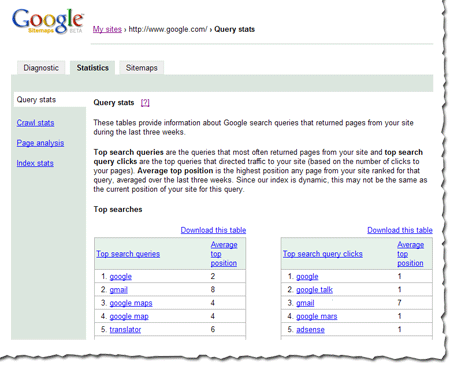
Google Sitemaps is a great way to analyze whether Google has indexed all your pages on all of your domains. Furthermore you can monitor the Page Rank on all of your domain and see all the search terms in Google that resulted in traffic to your domain pages. In Sitemaps you can now also see what your position is on the search results for terms you received clicks from.
Google Sitemaps is a great way to analyze whether Google has indexed all your pages on all of your domains. Furthermore you can monitor the Page Rank on all of your domain and see all the search terms in Google that resulted in traffic to your domain pages. In Sitemaps you can now also see what your position is on the search results for terms you received clicks from.
I will have future articles on Google's latest creation in the very near future as I start to test using sitemaps for several of my domains. Sitemaps has the possibility to be a major development in the way Search Engine Marketing professionals address managing and updating their sites within Google's search engine.

Subscribe to:
Posts (Atom)